
 National

Who  Sprott Money suits
Sprott Money is a strong fit for personal bullion owners who want allocated ownership records and segregated storage rather than keeping their holdings at home. Its storage FAQ describes customer-assigned boxes and records under the owner's name. Those are concrete reasons to consider the service for an existing holding, not a claim that bullion becomes a safe investment.
The company also has a separate US retirement route. Its IRA guide names  Equity Trust and offers help establishing an account. That service belongs in the retirement comparison; the private vault agreement belongs in the personal-ownership comparison. Choose between them according to where your money is held and whose name must appear on the account.
The  Silver Gold Bull review is more relevant if keeping your chosen IRA administrator is the priority. Its custodian policy explicitly permits customer choice, although the institution must still accept the transaction.
The  Kitco review covers another dealer with a separate IRA arrangement. That is a fair account-service comparison, rather than a reason to treat Sprott's Canadian base as disqualifying.
What Sprott Money offers
Sprott Money's FAQ describes selling investment-grade bullion for physical delivery or storage. Its Canadian base makes currency and destination important to the order. Ask whether each quotation is in US or Canadian dollars, which exchange rate applies and whether conversion, payment or delivery charges are separate. Two figures with a dollar sign are not comparable until their currency and terms match.
The company also describes private storage. The FAQ says customer metal is segregated and allocated, with records identifying the holdings. Ask for the actual storage agreement, the selected facility and applicable insurance details before relying on those general descriptions. Storage for a person or business can have different terms from a retirement account.
For a US IRA, verify the exact coin or bar with the selected custodian. The IRS IRA FAQ sets out collectible restrictions and exceptions for qualifying bullion and coins. A product available for direct purchase is not automatically accepted by your administrator. Have the institution confirm the item and the permitted depository before directing the transaction.
Product denomination affects both the purchase and a later sale. Ask for quotations on comparable eligible items with the same total metal content, and request an indicative bid for each. Smaller units can be convenient for a partial sale but may carry different combined premiums. Choose based on the complete price and your expected use, not only the number of pieces.
US IRA custody and funding
Sprott Money publishes a US IRA route through Equity Trust. Its IRA account guide describes specialist onboarding assistance and US storage choices with segregated and unsegregated arrangements. A US saver can therefore evaluate an actual retirement service, rather than trying to convert a personal storage account into an IRA.
The dealer, administrator and vault perform different jobs. Sprott supplies the bullion; the account institution administers your retirement ownership and the permitted instructions. The storage agreement identifies where the metal is kept and how it can move. Before funding, the application should name the administrator and the selected depository, with confirmation that the exact product is accepted. Do not substitute a private-storage rate for the IRA's contracted charges.
The IRS IRA guidance distinguishes trustee transfers, rollovers and contributions. Your existing institution and receiving administrator need to identify the permitted route for your funds. A tax adviser can assess your individual circumstances, especially if the proposal involves paying money to you before the new account receives it.
The guide's named relationship is useful evidence of an available service model, but it does not establish that every custodian or depository will serve every applicant. If you want to retain an existing administrator, resolve that acceptance before locking a bullion price. Otherwise, the attraction of a particular product could leave you opening a different account than you intended.
Canadian registered accounts are a separate service. The FAQ identifies Questrade in that context, rather than Equity Trust. Keep the country's account rules and the named institution attached to the agreement you are considering. A Canadian retirement label is not interchangeable with a US IRA, even when the same dealer supplies the metal.
Segregated private storage
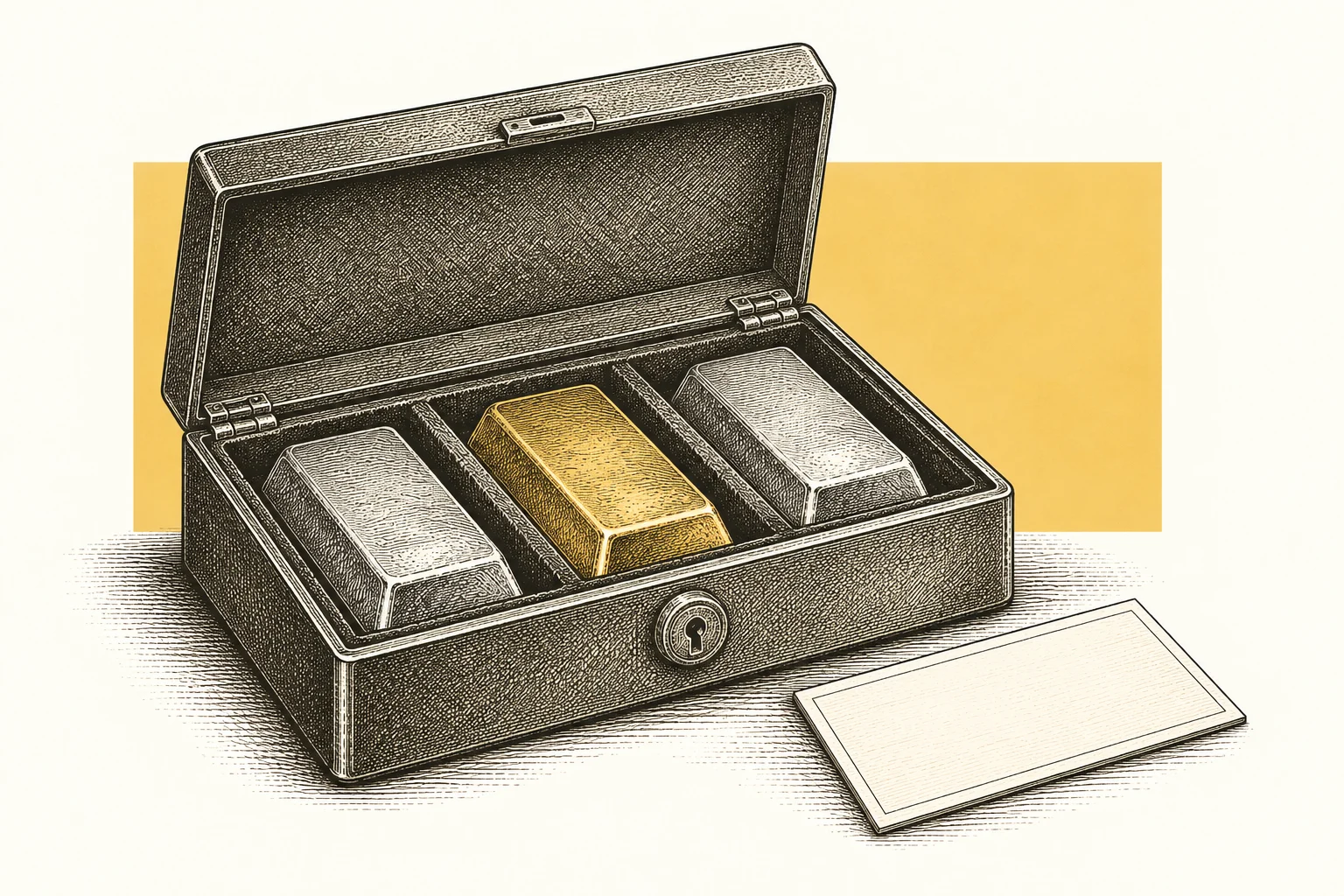
Sprott's private storage combines separation of the metal with identification of its owner. The FAQ defines segregation as individual customer-assigned boxes and allocation as records in your name with direct ownership. A holder seeking those two features has a clearer reason to choose this service than someone who only wants exposure to changes in gold's price.
The FAQ describes non-bank storage through Brinks, IDS and a Cayman Islands location. It says storage fees include insurance and distinguishes customer holdings from the dealer's own metal. The individual contract should still identify the facility, insured interest, valuation and exclusions. Allocation tells you whose holding is recorded; insurance addresses covered losses. Neither tells you the future resale price.
Sprott says it arranges independent annual audits and supplies a holdings report afterward. Customers can also arrange an accompanied self-audit, with advance written notice and a quoted charge. This offers an inspection route for a personal owner who wants more than an electronic balance, while requiring an appointment rather than unrestricted vault access.
The account-opening requirements include identification, with additional entity documents for business owners. The FAQ also describes monthly holdings reports and separate invoices for separate storage locations. For a business or a family dividing bullion among facilities, that means the records and bills should be reconciled by location; a single overall account value is insufficient to identify where each item sits.
Sprott says customers retain their metal if it or a storage facility fails, with withdrawal or transfer options. Treat that as the company's description of the ownership model, rather than a guarantee of immediate recovery in a legal dispute. The storage contract and records of the specific property are the documents that would matter if you had to assert that ownership.
Prices, currencies and storage charges
Request a written quotation that states the currency, exact product, quantity, payment method and expiration. Ask the company for the current schedule and identify the currency of every figure.
A storage rate can depend on the value of the holdings, the facility and minimum charges. Obtain the complete schedule for the proposed account and ask whether insurance is included. If an IRA custodian also charges account administration, keep that schedule separate from the private vault's pricing. Do not apply one service's rate to another without written confirmation.
Ask for a complete purchase quote alongside a current bid for that product in the same currency and at the same time. Their difference is the immediate spread. The spread checker can illustrate the arithmetic, but it cannot forecast a future bid. If one offer requires currency conversion, request the all-in amount after the exchange rate and any conversion charge.
Separate the costs by the party charging them:
- The dealer quote in a clearly labeled currency, including the selected payment method.
- Shipping, insurance and any conversion or bank charges for the intended destination.
- Custodian opening, administration and transaction fees for a retirement account.
- Vault storage and insurance charges for the chosen facility and ownership arrangement.
- Costs to sell, transfer, withdraw or ship the metal later.
Use the fee calculator only after converting comparable amounts consistently and recording the assumptions. Keep missing amounts open until the relevant provider confirms them. Mixing US and Canadian dollars can make a proposal appear less expensive without showing the actual difference.
Selling bullion to Sprott Money
Sprott Money's FAQ says its normal buyback policy focuses on bullion purchased from the company to preserve its chain of integrity. A narrow exception covers outside metal in a “said to contain” account at IDS Mississauga, subject to case-by-case verification and testing. Those distinctions matter if you plan to sell a product bought elsewhere. Ask for the current policy for the exact item before relying on a future sale.
Request a written bid, the currency of payment and the conditions for inspection, testing and shipment. Ask whether transport, wire or testing charges reduce the final payment. Obtain a current schedule and calculate the proceeds after every applicable cost.
If metal is held in private storage, ask whether the vault can transfer it directly for sale or whether it must be shipped. Confirm who authorizes the movement and when the price becomes binding. If the holding is in an IRA, the custodian must explain its own sale instructions and where the proceeds remain. A personal-account procedure does not automatically govern a retirement transaction.
A dealer's bid can be lower than your original purchase price. Compare offers for identical items in the same currency, and include conversion, transportation and inspection expenses. A higher gross offer may result in lower net proceeds once those charges are considered. A present indication helps compare offers but cannot promise a future price.
The FAQ also reserves the right to reject a sale request based on inventory, market conditions or product specifications. Storage authorization is therefore not a standing obligation to purchase every item whenever you choose. For shipped metal, receipt and verification precede payment; for stored metal, the completed transaction authorization is central. The same FAQ gives different timing descriptions, so obtain the expected settlement for your actual request rather than treating a general turnaround statement as guaranteed cash access.
Delivery, payment and cross-border questions
Sprott offers withdrawal and transfers between its storage facilities, so private storage need not end with a sale back to the dealer. Its delivery and transfer terms call for a transaction or withdrawal form. The company can arrange courier shipment, and customers may arrange collection from the storage location.
A complete withdrawal requires advance business-day notice and carries an administration charge plus shipping and insurance. A facility-to-facility transfer also requires a form, with a location- and holding-dependent quote. Those procedures make the service better suited to planned custody than to metal you need to collect immediately for an unexpected expense. Obtain a dated movement quote before choosing a location chiefly for its storage charge.
High-value shipments may need an armored courier. For any destination, the final order should specify the recipient, transport arrangements, insurance and applicable duties or taxes. The carrier available for one package or jurisdiction may not be suitable for another. After personal delivery, responsibility for secure possession moves into your own arrangements.
Keep the item-level invoice, vault statements and withdrawal confirmation together. On release, reconcile the product and quantity against the account's records. If you paid extra to preserve a particular product or identification detail, establish that requirement in the movement instruction. A correct weight alone may not answer a dispute about which product should have been returned.

Hypothetical example: comparing US and Canadian quotes
A Canadian-dollar sticker price can look higher while producing a lower US-dollar total. This hypothetical compares ten identical one-ounce gold coins offered by two fictional dealers. It is not a Sprott quote, a current metal price or a current exchange rate. Both offers deliver the same products to the same approved destination; all amounts are assumed, and no tax is due in the illustration.
| Assumed input or calculated result | Canadian-dollar offer | US-dollar offer |
|---|---|---|
| Gold being compared | 10 troy ounces | 10 troy ounces |
| Metal purchase price | CAD 30,000 | USD 22,500 |
| Shipment and insurance | CAD 100 | USD 100 |
| Assumed conversion rate | USD 0.75 per CAD 1 | No conversion |
| Bank or conversion charge | USD 30 | USD 0 |
| Converted metal and shipment | USD 22,575 | USD 22,600 |
| Total delivered purchase outlay | USD 22,605 | USD 22,600 |
| Assumed same-time gross resale bid | CAD 29,000 | USD 21,800 |
| Assumed resale shipment and insurance | CAD 100 | USD 100 |
| Assumed resale bank/conversion charge | USD 30 | USD 0 |
| Net resale proceeds at the assumed rate | USD 21,645 | USD 21,700 |
| Purchase outlay less net resale proceeds | USD 960 | USD 900 |
The US-dollar offer is only marginally cheaper to acquire under these assumptions, but it leaves more cash after the illustrative immediate resale. The Canadian offer's gross bid is not directly comparable until the resale transport and conversion costs have been included. Comparing only the bullion invoice would miss both differences.
The currency exposure also survives the purchase. If the assumed resale conversion rate were USD 0.70 per CAD 1, with every Canadian-dollar input unchanged, the Canadian offer's net resale proceeds would be USD 20,200. Its difference from the original purchase outlay would then be USD 2,405. That sensitivity is an arithmetic illustration, not a prediction about either currency or gold.
No annual custody or storage is included because this is a delivered, immediate-resale comparison. For a stored holding, add the same period and the actual applicable account charges before deciding. The useful judgment is narrower than “buy in the cheaper currency”: choose on the complete converted cost and the payment currency you will need when you exit.
Risks and questions before purchase
Sprott's strongest reason to buy is the private owner's combination of allocated records and physically separate custody. It is a weaker match for someone who needs unrestricted access to cash or expects the dealer to buy any metal from any source. Bullion pays no income, and its market value can fall while storage and transaction expenses continue.
The CFTC's metal-buyer guidance stresses seller compensation and written costs. An IRA administrator accepting an asset does not make that asset suitable for your entire retirement portfolio. Decide how much liquidity must remain elsewhere before tying money up in a physical holding.
Resolve three decisive points before signing:
- Name the actual account owner, administrator if applicable, and storage facility in the agreements.
- Obtain one complete purchase quote and net exit illustration in a currency you can compare.
- Record the withdrawal rights and the buyback policy for your particular products and their purchase origin.
Choose Sprott for the custody features you will actually use. For retirement funds, evaluate its documented Equity Trust route on its own contract; for a chosen outside administrator, start with explicit custodian acceptance. The product, ownership records and exit rights should remain consistent from the invoice to the final release.
Sprott's full FAQ and the independently retrieved IRA guide naming Equity Trust, alternative-dealer policies and US federal guidance. A separate browser attempt returned an access error; that attempt does not invalidate the successful primary-text retrieval. Historical storage research is dated 24 October 2026. No current numerical provider fee is quoted.Frequently asked questions
Does Sprott Money offer a US IRA route?
Sprott Money offer a US IRA route?Yes. Sprott publishes an IRA guide naming Equity Trust and specialist help with account setup. That is separate from its ordinary private-storage account. Obtain the current custodian agreement, accepted-product confirmation and depository terms before funding; private allocation and segregation alone do not create a US retirement account.
What do segregated and allocated storage mean?
Sprott Money's FAQ describes segregated metal as kept separately in customer-assigned boxes and allocated holdings as recorded under the customer's name. Read the agreement for the selected facility to understand ownership records, movement instructions and insurance. Those terms should not be assumed to apply identically to an IRA.
Will Sprott Money buy metal purchased elsewhere?
Sprott Money buy metal purchased elsewhere?Possibly, subject to its case-by-case terms. Its FAQ describes a normal buyback policy focused on metal bought from the company, with case-by-case review and testing for certain outside holdings in storage. Ask for the current written terms for your exact item, including inspection and charges, before relying on that route.
How should a US buyer compare prices?
Confirm whether every quotation and fee is in US or Canadian dollars. Use a disclosed exchange rate and include conversion, bank, shipping and insurance costs. Compare the same product and obtain an indicative sale bid in a consistent currency; the resulting figure is not a forecast.