
 National

Who  Vaulted suits
Vaulted is a good fit for personal savers building a stored metal position without taking immediate responsibility for home safekeeping. Its FAQ describes gold allocated at the Royal Canadian Mint and silver at HSBC in London. The useful feature is a documented interest in professionally held physical metal, rather than simply an app that follows a reference price.
It is less suitable for a buyer whose main goal is receiving a particular retail coin immediately. The physical-delivery route has funding and product restrictions, and converting a stored position to smaller products can reduce the ounces delivered. A vault-first account serves a different purpose from a direct purchase for possession.
The  McAlvany Precious Metals review is the appropriate comparison for retirement money. Its separate IRA service includes a custodian and retirement storage arrangement. Choose that legal account structure when the assets must remain inside an IRA.
The  Sprott Money review covers both personal storage and a separately documented retirement route. Its US IRA guide names
 Equity Trust and onboarding assistance. That gives an IRA buyer another actual account service to compare, subject to the current custodian and storage agreements.
What Vaulted offers
Vaulted describes digital purchases of physical gold and silver with metal held at professional facilities. Its FAQ says gold is allocated to bars at the Royal Canadian Mint and silver is held in segregated bars at HSBC in London. The platform's account records and agreement should explain how a customer's interest in the stored holding is documented and how a sale or delivery is requested.
The product is different from buying an individual retail coin and taking it home immediately. Ask whether the account represents ownership of a specified quantity within larger bars, how the platform records that interest and what documentation you receive. If your aim is to own a particular coin in your possession, compare the delivery process and resulting product with a direct bullion dealer's offer.
VaultPlan supports recurring gold or silver purchases monthly or every two weeks, with an amount and frequency that can be changed. The plan description connects the instruction to your linked checking account. Spreading purchases across dates does not guarantee a lower average price or prevent losses. Ask how to change or stop the instruction, when a purchase price is fixed and what happens if a bank payment fails. Review the current agreement before treating an automated plan as a substitute for an allocation decision.
The platform's FAQ describes an option to sell through the account. Ask how the bid is determined, when it is binding and how proceeds are transferred. Physical possession, a vault-held position and a retirement-account holding are different arrangements. The transaction documents should identify which one you are using.
Is Vaulted a gold IRA?
An ordinary personal Vaulted account is separate from a self-directed IRA. McAlvany Precious Metals offers its IRA service through a distinct account arrangement. A shared group connection does not turn a personal metal purchase into retirement-account ownership.
The account title and the receiving institution determine which process you are using. A retirement proposal needs an identified custodian, an accepted product and approved storage. The IRS IRA guidance distinguishes transfers, rollovers and contributions and limits collectible purchases, with defined exceptions for some coins and bullion. A payment into a personal platform account is not automatically any of those retirement funding routes.
For money already in an IRA or workplace plan, resolve the receiving account with the existing institution before moving funds personally. A tax adviser can assess the proposed transfer or distribution and your individual consequences. Vaulted's own marketing about tax treatment is not a substitute for that advice, and no particular tax rate or outcome should be assumed from holding physical gold through an app.
For non-retirement money, the ordinary account may be the intended arrangement. The decision then rests on the legal rights to the allocated metal, storage and access terms, and eventual delivery or sale. That is a coherent personal holding without needing to attach an IRA label to it.
Gold and silver storage
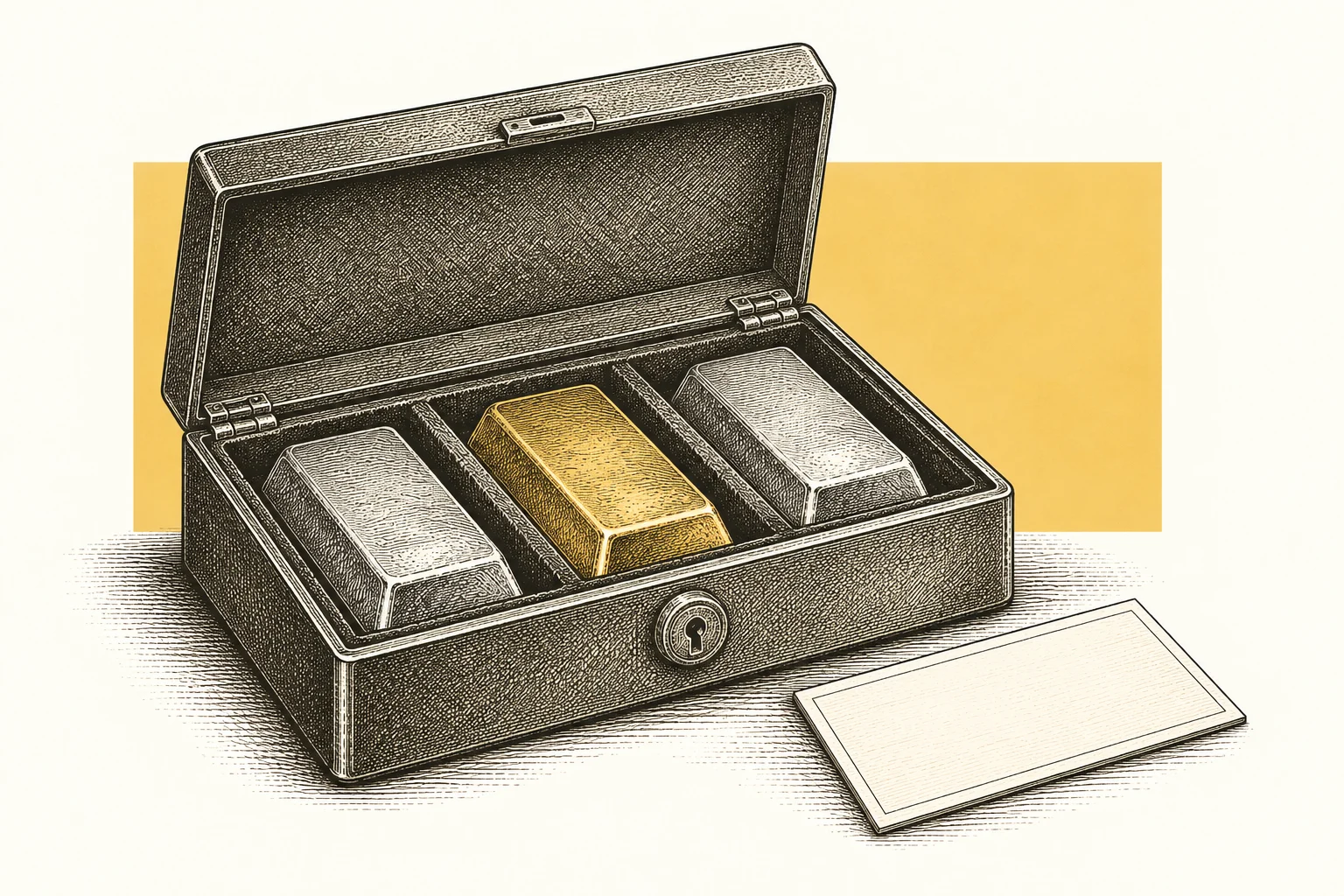
Vaulted's FAQ says gold is held at the Royal Canadian Mint in Ottawa and silver in HSBC vaults in London. The locations and product forms differ, which matters if you want physical delivery or have a preference about where assets are held. Confirm the facility and the rights associated with your own account in the current agreement.
The FAQ describes gold as allocated and silver as physically segregated. Ask what those terms mean for a customer holding less than a whole stored bar, how the quantity is recorded, and what documentation identifies the holding. A product description can explain the storage model, but the contract should address your ownership rights and the process if the provider or a storage counterparty has a problem.
Review insurance independently. Determine the insured party and covered risks, the valuation method, exclusions and claims process. Determine whether coverage applies during a delivery or only while the metal is in storage. The facility's insurance claim does not describe every term of the policy for your individual account.
Jurisdiction can matter to access and administration. A US customer should ask how a Canadian or UK storage location affects delivery, documentation and any applicable tax reporting. The company and your independent adviser can explain different parts of that question. Do not assume that the location of the vault determines the tax treatment of the account by itself.
The end user agreement describes the transaction more precisely than the word “allocated.” An accepted buy order creates a prepaid forward contract for physical delivery. It says specific bars or non-overlapping sections are allocated as security for the provider's obligations, with title held by the customer as nominee. This is a contractual structure to understand before equating the balance with coins already delivered into your possession.
The agreement distinguishes whole bars from sections of bars. Sections are tracked by their location within an identified bar, and the provider may change section identifiers to avoid fragmentation. It says the allocated metal cannot be pledged for another party. Those details explain why a serial number is meaningful without implying that a fractional holder can demand that a physical slice of the bar be cut out and shipped.
The cash side is different again. The agreement says the Vaulted Cash Account does not earn interest and is not FDIC insured. Money waiting for a purchase or left after a sale should therefore not be treated like an insured bank savings balance. Keep emergency cash needs separate from both the metal price exposure and the platform's withdrawal process.
Vaulted prices and ongoing charges
The total cost includes the purchase price relative to the reference metal price, ongoing account or storage charges and the amount received when you sell or take delivery. Vaulted's FAQ describes its pricing and fees. Request the current schedule and an account-specific quote.
Ask for a buy quote and a contemporaneous sale quote for the same quantity and metal. Their difference is the immediate spread. It can change and does not predict the future market or the price available when you sell. The spread checker can illustrate the arithmetic using the amounts displayed or confirmed for your transaction.
A recurring maintenance charge can matter more over a long holding period. Ask whether it is assessed on account value, how often it is collected and how the company handles insufficient cash in the account. If gold and silver have different schedules, model them separately. The fee calculator can compare stated assumptions but cannot supply a missing rate or forecast the metal's value.
Physical delivery can introduce another cost. Ask which retail products are available, whether a conversion from vault holdings is required, and what premium, shipping and insurance charges apply. A platform purchase that looks inexpensive to hold may cost more to receive as small coins or bars. Compare the final delivered product and quantity with a direct bullion dealer's offer.
Selling through Vaulted
Vaulted lets you sell all or part of a holding through the platform, but selling metal and withdrawing cash are separate actions. The account agreement says sale proceeds enter the Vaulted Cash Account and may not be immediately available. They can remain for later purchases or be transferred to your bank under the withdrawal terms.
The agreement also treats an order's indicative price differently from its execution price. It allows processing windows tied to market hours and warns that the price may move between order and execution. A display seen when markets are closed is therefore not a guaranteed sale price when processing resumes. Use the final confirmation to reconcile the quantity sold, actual proceeds and any charges.
Recurring purchases create acquisitions at different prices. Retain those confirmations and the statements identifying the holding. The agreement describes its usual selection of higher-cost open purchases when calculating a sale's gains or losses, but your tax adviser must assess your individual reporting. The platform's record-keeping method should not be treated as a promise of lower tax.
For a personal holder who may sell in stages, the fractional account structure can serve a different purpose from retail coins that must be sold as whole pieces. The important constraint is cash access after the trade, not merely whether a sell button exists. Keep enough liquidity outside the platform for expenses that cannot wait for verification or bank processing.
Physical delivery and access
Vaulted currently limits physical delivery to US addresses and does not support shipping your specific serial-numbered stored kilo bar. Its delivery FAQ instead describes settling that interest and supplying other products from US inventory. Smaller coins and bars carry additional premiums and spreads, so the delivered ounces can be fewer than the stored ounces.
The linked end user agreement contains broader whole-gold-bar delivery language. That does not resolve the FAQ's current operational restriction. If receiving the exact numbered bar is essential, obtain written clarification before purchasing; neither a serial number in the app nor general contract wording should be treated as a confirmed shipment commitment.
ACH funding adds another constraint. The FAQ says cash withdrawal requests can remain pending during a 60-day window after ACH funding. For earlier cash access, it describes verification using a recent bank statement, identification and a voided check. That is an early-cash verification route, not a promise of immediate payment or an exception automatically authorizing physical delivery.
The physical-delivery answer separately says ACH-funded purchases must remain in the account for 60 days before delivery requests can be processed. Identity verification also applies. The FAQ distinguishes buying and selling from withdrawal: the funding restriction does not prevent gold trading, while wire funding avoids that ACH window. If the intended bank withdrawal differs from the funding method, additional linked-bank verification can still be required.
For an eventual retail shipment, obtain the exact product, final quantity and charges before authorizing conversion. The FAQ says transit is insured, but the current order and coverage terms should explain the recipient and claims process. After receipt, secure storage and insurance become your own planning task. Vault-first ownership fits someone comfortable with those exit procedures; a buyer who needs immediate possession should arrange a direct purchase of the actual item instead.

Hypothetical example: storage or direct delivery
The cheaper route can change with the time spent in storage. This hypothetical compares fictional offers that both end with ten one-ounce gold coins in the buyer's possession. Neither offer is a Vaulted quote. Assume a constant gold valuation, fixed annual charges, no investment return and no tax. The vault-first offer explicitly consumes an assumed 0.2 ounce as its retail-conversion premium, so the buyer starts with more metal to receive the same final quantity.
| Assumed input or calculated result | Fictional vault-first offer | Fictional direct-delivery offer |
|---|---|---|
| Initial fine-gold quantity | 10.2 troy ounces | 10 troy ounces |
| Initial metal/product purchase | USD 25,500 | USD 26,000 |
| Metal consumed by conversion premium | 0.2 troy ounce | None |
| Final delivered quantity | 10 troy ounces | 10 troy ounces |
| Shipment and insurance, once | USD 100 | Included in purchase price |
| Home safe, once | USD 0 | USD 300 |
| Storage or home insurance per year | USD 150 | USD 50 |
| Other bank, transaction or tax costs | USD 0 | USD 0 |
| Total outlay after 1 year | USD 25,750 | USD 26,350 |
| Total outlay after 7 years | USD 26,650 | USD 26,650 |
| Total outlay after 10 years | USD 27,100 | USD 26,800 |
The fictional vault-first route costs less over a short holding period because the delivered retail product and safe cost more upfront. The annual charge eventually reverses that advantage: these schedules meet after seven years, and direct possession costs less after ten. That result depends on the stated inputs, including the cash cost of buying enough extra metal for the assumed conversion.
Vaulted's actual conversion is not assigned this 0.2-ounce amount or any fixed ratio. Its current FAQ says the products and delivered quantity change with premiums and fees. To use this model for a real order, obtain the total stored position required to deliver the specified coins and the complete quote. Comparing ten stored ounces against ten delivered ounces without accounting for conversion would overstate equivalence.
The table models direct possession throughout the period on one side and conversion at the end on the other. It does not value the convenience of a professional vault or the responsibility of home safekeeping. Those are reasons to choose a structure, even when another structure has a lower modeled dollar cost. No resale proceeds or tax consequences are forecast.
Risks and questions before buying
Metal prices can fall, and bullion itself generates no income. A concentrated holding carries market exposure as well as transaction and storage expenses. Assess the allocation against your wider savings and likely liquidity needs.
The CFTC guidance for metal customers recommends identifying how a metal seller earns money. Ask Vaulted how its purchase price, sale bid, maintenance charges and delivery premiums apply to your transaction. An allocated storage description does not eliminate price risk.
Before opening an account, establish:
- Whether the intended account is personal or a separately confirmed IRA arrangement.
- Where each metal is held and what rights the storage agreement gives you.
- The current purchase, sale and maintenance terms for the selected quantity.
- The available delivery products, waiting conditions and complete shipment costs.
- The process for selling part of the position and transferring proceeds.
Choose Vaulted for a personal allocation you intend to hold professionally, with the agreement's ownership and withdrawal structure understood. Choose a separate custodian-administered service for retirement ownership, or a direct retail order when possession of a particular product is the immediate goal. The route should match how you expect to use the metal, not simply how easy it is to initiate a purchase.
Vaulted's full FAQ and linked end user agreement, McAlvany's separate IRA material, Sprott's independently retrieved Equity Trust guide and federal guidance. The FAQ's current numbered-bar delivery limit differs from the agreement's broader language and remains a contract-specific clarification. Earlier research is dated 24 October 2026. No current numerical platform fee or individual tax outcome is asserted.Frequently asked questions
Is an ordinary Vaulted account a self-directed IRA?
Vaulted account a self-directed IRA?No. An ordinary personal Vaulted account is separate from a self-directed IRA. McAlvany Precious Metals describes a distinct IRA service with custody and retirement storage arrangements. If retirement ownership is your goal, identify the receiving custodian and permitted funding route before moving money from an existing IRA or workplace plan.
Where does Vaulted say it stores metal?
Vaulted say it stores metal?Vaulted's FAQ says gold is held at the Royal Canadian Mint in Ottawa and silver in HSBC vaults in London. It describes gold as allocated and silver as segregated. Read the current account and storage agreements for the specific rights, insurance and delivery terms that apply to you.
Can I receive physical metal?
Yes, subject to US delivery and account conditions. Vaulted currently supplies alternative retail products rather than shipping your specific stored serial-numbered kilo bar. Premiums and fees can reduce the delivered ounces. The FAQ also gives a 60-day physical-delivery restriction for ACH-funded purchases, separate from its early-cash verification procedure.
How do I sell a Vaulted holding?
Vaulted holding?The company describes selling through its platform. Review the current bid, applicable charges, settlement and bank withdrawal conditions before confirming a sale. The amount received can differ from your purchase price because the metal market and the platform's buy and sell quotations can change.